Perelman Theater - Kimmel Center for the Performing Arts April 28-29, 2011 300 South Broad Street
Philadelphia, PA 19102
The world premiere of a new one-act, vaudeville-style opera, Danse Russe, with music by Pulitzer-prize winning composer Paul Moravec, based on an original libretto created by Wall Street Journal drama critic and biographer Terry Teachout. Danse Russe tells the story of the creation of Stravinsky’s Rite of Spring through the eyes of its creators: Diaghilev, Nijinsky, Monteux and, of course, Stravinsky.
This new chamber opera is being paired with the Philadelphia premieres of Stravinsky's short chamber opera Renard (The Fox) and his ballet Ragtime. CCOT will collaborate with award-winning Orchestra 2001 and the Kun-Yang Lin/Dancers (KYLD), a nationally recognized contemporary dance company based in Philadelphia.
The piece was written in 1997 for the 70th birthday anniversary of my late father. (http://hu.wikipedia.org/wiki/Ber%C3%A9nyi_Ferenc)
The first performance was in October 28, 1999 at the Budapest Autumn Festival, Inaugural Concert of György Kurtág at Hungarian Academy of Sciences.
Both recordings are live performances of Petra Berényi in Mallarme Chamber Players series in Durham, NC. (2007)
1.) Strings (proper size and amount for each note)
For the treble part only there are 80 pieces for a concert cimbalom.
These strings are basically piano strings. Has a loop end on one side.
2.) Tuning wrench
3.) String lifter (in order to make sure the string spiral on the tuning pin will be under each other, not criss crossed, and not having big gaps in between them.
4. Curved jaw locking plier (for fixing the loop end of the string on the left side of the cimbalom)
5.) another plier to make the "L" shape the end of the string in order to start turning it around the tuning pin.
With practicing you will get a good estimation of how much you need to turn the pin in. After putting the string on it should not sit neither too high or too low.
The best result if you still see the thread (spiral) about 2 milimeter after putting on the new string..
!!!! Warning!!!!!
Make sure you don't make a mistake like on this picture: Apparently the person who put this on didn't use string lifter. You see the loops "naturally" going down on the pin...some of them even goes over the thread, which is very bad. Not even mentioning the inaccurate estimation of the height of the peg.
Also you will need a hammer and a copper rod with a flat end.
The copper rod has been used to move the string out from the tuning pin (if necessary) or lifting the old string loop up over the pin. We need a softer metal than steel in order to avoid to "injure" the strings when you for example hammer on the left loop to make it tighter around the pin.
Lifting up the old loop end from the pin, and hammering the new string loop end over the pin.
Result should be nice even loops around the pegs with the proper height of the pins. You just need to tune.
Dracula, Music by J. Mark Scearce
Adaptation and Choreography by Lynne Taylor-Corbett
Scenic Design by Jeff A.R. Jones
Costume Design by David Heuvel
Dracula….........................................................MARCELO MARTINEZ, Dr. Seward (the narrator)…..............................ALAN CAMPBELL, Lucy Westenra….............................................LILYAN VIGO, Mina Harker....................................................MARGARET SEVERIN-HANSEN, Arthour Holmwood….......................................ATTILA BONGAR, Jonathan Harker..............................................GABOR KAPIN, Renfield….........................................................PABLO JAVIER PEREZ, Dr. Van Helsing….............................................MARIN BOIERU, The twisted sisters….........................................RANDI OSETEK with ALICIA FABRY,
............................................................................ASHLEY HATHAWAY
The shadows………..........................................Sean Armstrong, Olivér Béres, Adam Crawford Chavis, ............................................................................Adam Schiffer Jack and Colette (Dockworker Sweethearts)....ERICA SABATINI, NIKOLAI SMIRNOV
Dockworkers, Servants, Sea Captain, People of London……….................................Taisha Barton-Rowledge, Malea Grubb, Sarah Newton, ..........................................................................Elizabeth Ousley, Ayla Weisz, Sean Armstrong, Oliver ..........................................................................Béres, Adam Crawford Chavis, Adam Schiffer, Children of London………………………......Frances Williams and Grace Costigan, Emily Hall,
..........................................................................Timmy Hunn, Taylor Hunn, Maddy Kunkel,
MUSICIANS Conductor: Alfred E. Sturgis Violin: Michael Danchi, Viola: Michael Castelo, Cello: Jonathan Kramer, Bass: Greg Watkins, Oboe and English Horn: Carrie Shull, Clarinet and Bass Clarinet: Chris Grymes, Horn: Michael Hrivnak, Percussion: Shawn Galvin, Harp: Jacquelyn Bartlett, Cimbalom: Petra Berenyi, Vocal Soloists (The Masque of the Red Death) Baritone: Christopher Nowlan, Bass: Tom Nelson
On the right you can see the mallet what I can just dream about.... It has one of the most beautiful sound I have ever heard! It is used by my former cimbalom teacher Ilona Szeverényi.
These AR mallets are named after Aladár Rácz who invented this type. My former teacher's mallets were made by her late husband (Ferenc Gerencsér, cimbalom player and former professor of Liszt Ferenc Academy of Music, Aladár Rácz's student) who had worked on a very high standard, including the high quality of wood, the workmanship and finish of the surface.
I think we all (cimbalom players) should follow him, making our own mallets, as oboists make their own reed! Unfortunately there are only few people whom can really make these kind of mallets. I am not sure these people will be always available rest of my life to get some help from, or simply purchase mallets from them...so I got motivated to try to make my own AR cimbalom mallets!
I found a person who has made a preliminary design of the handle parts and the sticks.
It has to be two different kind of wood. The handle must be something light, but strong what can be shaped easily. The handle can be white basswood and the stick (stalk) must be something hard wood (preferred acacia).
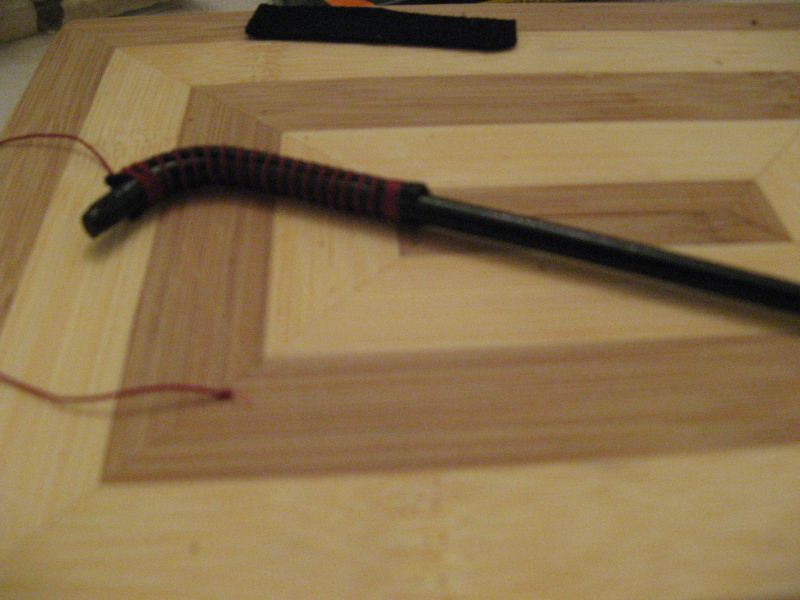
Here are the sticks after bending and one mallet after putting together the stalk with the handle....almost ready!
I had to make the sticks little "skinnier" using a very sharp tool. Before painting them I used two different kind of sandpapers to make them very smooth and remove minor knife marks.
During drying.....
After it dried.
Making the "heads" of the mallets:
first layer: leather without glue just strong thread around
After this step is done you need a thicker layer of leather over it fixing with glue, then put the felt and finishing with a soft layer of leather over the felt.
Cutting the felt.
pair of mallet with leather-felt cover combination